

Connect
Target credentials
The credential RequestRocket sends to the target.
A target credential is what RequestRocket presents to the upstream API. Its secret is encrypted inside RequestRocket; callers of your proxy do not receive it. The API stores the record as credentialType: "target".
| Auth type | Use it for | Main fields |
|---|---|---|
key | API key in a header or query | key, value, addToHeader |
bearer or jwt | Static token | token, addToHeader |
basic | HTTP Basic auth | username, password |
oauth2 | OAuth 2 grant | Fields depend on grantType |
customToken | Token fetched from a custom endpoint | tokenURL and mapping fields |
custom | Static header, query, or body values | additionalHeaders, additionalQueryParams, additionalData |
jwtSigned | A JWT signed for every upstream call | signingAlgorithm, claimsTemplate, and the matching key material |
passthrough | Forward supported inbound auth headers | No stored secret |
none | A target that requires no auth | Empty secret |
Create the credential
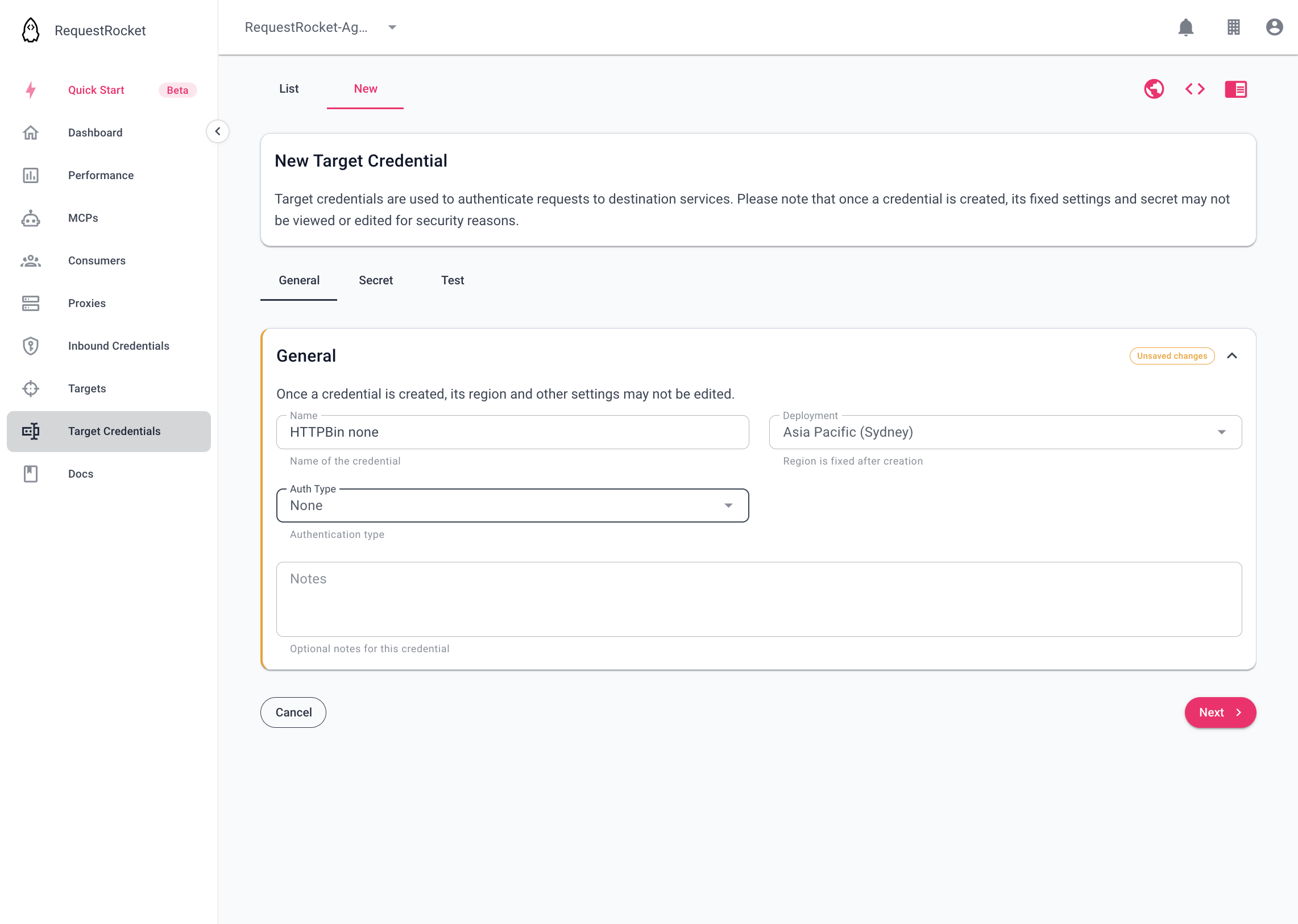
Open Target Credentials and open the New tab. Name it, select the target's region, and set the auth type to None for HTTPBin.
Result and rotation
Select the saved credential on a proxy or direct MCP server in the same region. To rotate secret material without changing the live proxy first, create a replacement credential, switch the proxy to it, verify one call, and then retire the old credential. The API does not update a saved secret or auth type in place.
Troubleshooting
- Choose
noneonly when the upstream API performs no authentication. - OAuth2 and custom-token credentials validate their auth-specific fields and can fail while obtaining a token.
- A pending credential cannot call a target until the recipient completes its one-time share link.